Birria Ramen: The Fusion Nobody Saw Coming
By La Bufa Mexican Restaurant · Westminster, Colorado
Birria Ramen: When Three Cities and Two Cultures Created the Perfect Bowl
You’ve probably seen it all over your feed — that deep red broth, the tangle of noodles, the shredded meat that falls apart at the touch of a fork. Birria ramen looks like it came out of nowhere. But this bowl has a story that runs through five centuries, three cities, and two cultures that had no idea they were headed toward the same bowl. Let’s break it down.
It Starts in Jalisco — 500 Years Ago
Birria didn’t start as a celebrated dish. It started as a problem.
When Hernán Cortés and the Spanish conquistadors arrived in Mexico in 1519, they brought European livestock with them — including goats. Those goats reproduced at an alarming rate, devastated crops, and caused famine. The Spanish weren’t fond of goat meat — it was tough, gamey, and difficult to cook. So they offloaded it onto the indigenous population of Jalisco.
What happened next is the kind of culinary alchemy that only comes from necessity. The indigenous people of Jalisco took that unwanted meat and slow-cooked it underground with local dried chiles, spices, and herbs until it became something extraordinary. The Spanish called it “birria” — a derogatory term meaning “worthless” or “something of little value.” The irony is that the dish they dismissed as worthless became one of Mexico’s most beloved and globally celebrated foods.
As Chef Aarón Sánchez put it: “Birria is one of the crown jewels of the state of Jalisco and represents the melting pot of Mexico between the indigenous ingredients and what the Spaniards brought over.”
The consommé — the rich, deep broth left behind after cooking — became the soul of the dish. You drink it. You dip your tortillas in it. You don’t waste a single drop.
Tijuana Puts It in a Taco
For centuries, birria stayed close to its Jalisco roots — a stew served at weddings, baptisms, and celebrations. Then it started moving north.
As Jalisco natives migrated toward the U.S. border, they brought their food traditions with them and settled in Tijuana. Tijuana took the birria stew and did something new with it — they put it in a taco. Around 2009, California food writer Bill Esparza spotted a Tijuana food truck called Tacos Aaron serving birria in taco form. Other taqueros started adding cheese to the birria taco, dipping the tortilla in the consommé before grilling it until crispy and stained red. The quesabirria was born.
By 2016, Tijuana taqueros brought quesabirria across the border into Los Angeles. By 2019, it had detonated on Instagram — long lines, cheese pulls, red-stained tortillas — and birria’s U.S. menu presence grew over 400% in roughly four years. Suddenly everyone knew what birria was. But the story wasn’t over.
Mexico City Adds Noodles
Here’s where ramen enters the story — and for that, we need to go back even further.
Ramen is not originally Japanese. Most historians agree it was brought to Japan by Chinese immigrants from the Fujian and Guangdong provinces in the late 19th and early 20th century. As Japan opened its ports during the Meiji Restoration in 1868, Chinese immigrants settled in port cities like Yokohama and introduced their wheat noodle soups. The Japanese adapted, refined, and regionalized it over generations until it became something distinctly their own — miso in Sapporo, tonkotsu in Hakata, shoyu in Tokyo. By the 1950s, ramen was no longer a Chinese import. It was Japanese.
Two immigrant food traditions — birria and ramen — had each traveled thousands of miles from their origins and been transformed along the way. It took a chef in Mexico City to realize they belonged together.
In 2015, celebrity chef Antonio de Livier added something new to his menu at Ánimo Ay Caldos! in Mexico City. He took birria consommé — that centuries-old, chile-rich, collagen-heavy broth — and served it over ramen noodles. He called it birriamen. The logic was simple and brilliant: a great ramen broth and a great birria consommé share the same DNA. Both are built low and slow. Both are fat-enriched. Both are designed to coat a noodle. His restaurant now sells roughly 350 bowls a day.
By 2019, birria ramen had made its way north to Los Angeles, where it spread through taco trucks and night markets. Short-form video did the rest — dramatic broth pours and cheese pulls turned birriamen into a scroll-stopping global sensation.
🍜 Dato curioso: The word “ramen” traces back to the Chinese “lāmiàn” — hand-pulled noodles. Both ramen and birria began as immigrant, working-class food before becoming globally celebrated dishes. Food has a way of doing that.
What We Do With It at La Bufa
At La Bufa, birria has always been part of our DNA. Our recipe comes from Fresnillo, Zacatecas — slow-cooked and deeply spiced, passed down from our grandmother’s kitchen.
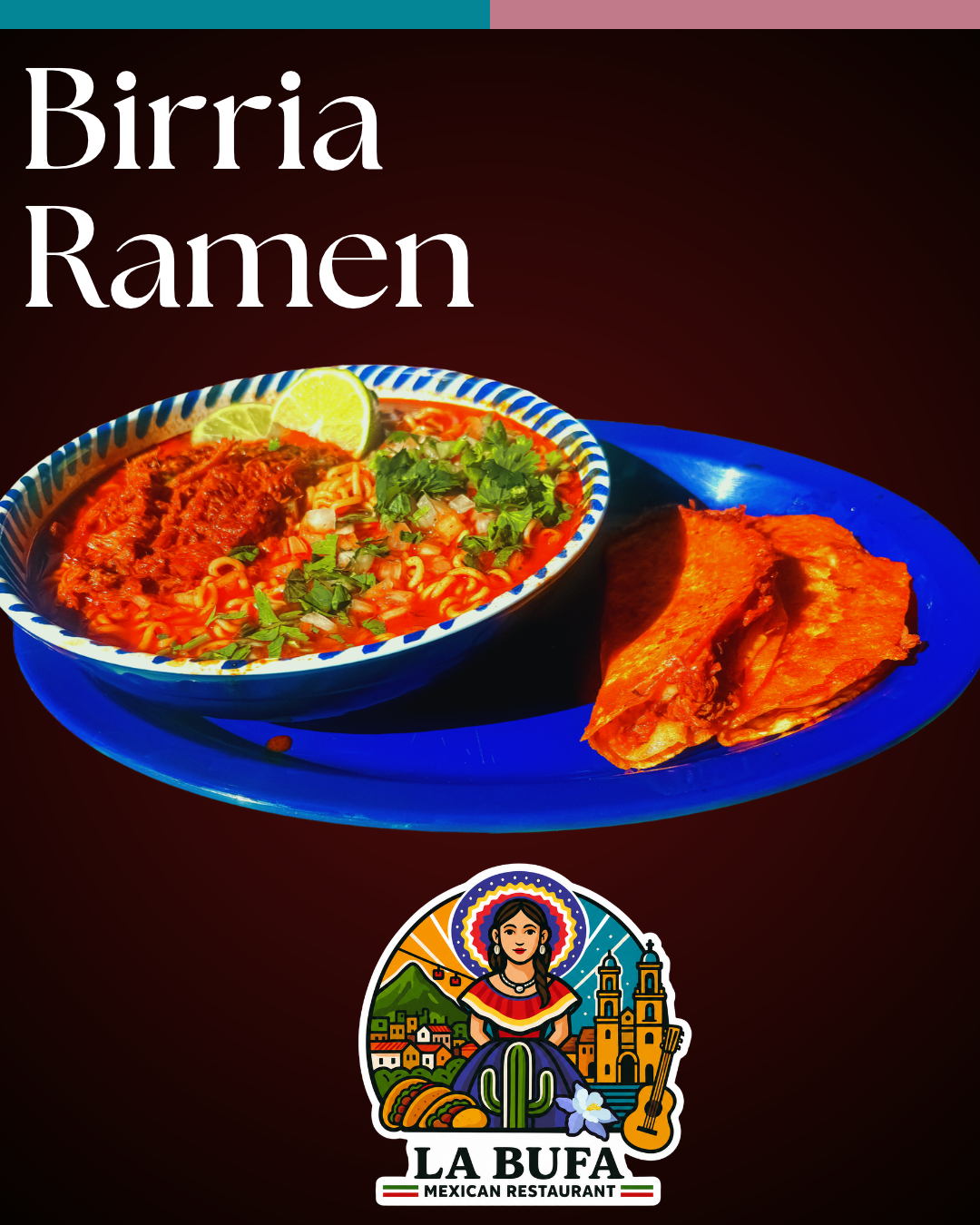
So we joined the fusion. Our birria ramen brings that Zacatecan kick to the bowl — rich consommé, the perfect noodle, and tender birria that has been part of our family table for generations. And to make sure you’re fully satisfied, it comes with two crispy quesabirria tacos on the side for dipping. Three evolutions. Two cultures. One bowl — with a Zacatecan soul.
Why This Bowl Matters
Jalisco transformed unwanted goat into a celebration dish. Tijuana put it in a taco and sent it across the border. Mexico City added noodles and gave it a new life. Los Angeles made it go viral. And here in Westminster, Colorado, we’re serving our Zacatecan version of that five-century-long story.
Food fusion gets a bad reputation sometimes — people call it inauthentic, or a trend. But birria ramen isn’t a restaurant gimmick. It’s what happens when cultures stop being strangers. Every bowl carries the fingerprints of the people who were told their food was worthless — and made it unforgettable anyway.
Come try it. And bring someone who’s never had birria before. That reaction is always worth it.
References & Further Reading
- What Is Birria? — Food Network
- The Untold Truth of Birria — Mashed
- Quesabirria — Wikipedia
- Ramen’s Rise from Street Food to Global Phenomenon — Nippon.com
- The Rarely Known Origin of Ramen — Tasting Table
- Birria Ramen Arrives in L.A. — L.A. Taco
- The Second Wave of the Birria Taco Trend — Kansas City Magazine
- This Mexico City Birria Mash-Up Is Taking Over L.A. — Time Out LA
La Bufa Mexican Restaurant · 7124 Federal Blvd, Westminster, CO · @labufadenver