Chile Relleno: 500 Years of History on One Plate
By La Bufa Mexican Restaurant · Westminster, Colorado
If you’ve ever sat down at La Bufa and ordered our Chile Relleno (or anywhere, for that matter), you were eating something with more history than most people realize. This isn’t just a stuffed pepper — it’s a dish that traces back to ancient Mexico, survived a colonial takeover, got cooked up by nuns for an emperor, and somehow ended up on a plate in Westminster, Colorado. Let’s talk about it.
It Started Long Before the Spanish Arrived
Here’s something that surprises a lot of people: the chile relleno isn’t a Spanish invention. Long before Spain ever set foot in Mexico, the Aztecs were already stuffing peppers. Chiles were one of the most important ingredients in Mesoamerican cooking — they weren’t just a side note, they were central to everything. The concept of filling a chile with something? That was already happening.
When the Spanish arrived in the 16th century, they didn’t replace that tradition — they layered on top of it. They brought cheese, eggs, and new cooking techniques. What came out of that collision of two culinary worlds is what we now call the chile relleno. It’s a mestizo dish in the truest sense — half indigenous, half European, and completely Mexican.
The Nun Story (And Why It Gets Complicated)
Ask most people where the chile relleno comes from, and you’ll hear the 1821 story — and it’s a good one. Legend has it that nuns from the Santa Mónica convent in Puebla prepared a special chile relleno for Agustín de Iturbide, the independence hero who signed the Treaty of Córdoba — the document that secured Mexico’s independence from Spain — and later became Mexico’s first emperor.
He stopped in Puebla on his way back to Mexico City to celebrate the feast day of his patron saint, and the nuns went all out. They created what we now call chile en nogada — a poblano chile stuffed with picadillo (ground meat, fruits, nuts, and spices), covered in a white walnut cream sauce, and garnished with red pomegranate seeds. Green pepper, white sauce, red seeds — the colors of the new Mexican flag. Pretty intentional.
Now here’s where it gets interesting: historians have pointed out that there’s no real documentation of that story until the 1920s, which means the nuns-for-the-emperor tale might be more legend than fact. What we do know for certain is that the first published recipe appeared in 1858, in a Mexican culinary encyclopedia called Nuevo cocinero mexicano en forma de diccionario. By the 1920s, chile rellenos were showing up in cookbooks everywhere.
The real takeaway? People were probably making versions of this dish for generations before anyone wrote it down. The nuns may have made a famous version of it, but they didn’t invent stuffed chiles. The Aztecs got there first.
One Dish, A Lot of Versions
Once the chile relleno started spreading, it didn’t stay the same everywhere it landed. That’s actually one of the coolest things about it — every region made it their own. It even crossed the border, where it got its own American culinary twist. The chile en nogada from Puebla skips the fry entirely and goes the walnut cream route. New Mexico took their beloved green chiles, stuffed them with cheddar, and finished the whole thing with red or green chile sauce. In most of the U.S., you’ll find the Anaheim pepper version — milder, easier to work with, usually stuffed with Monterey Jack and fried in egg batter.
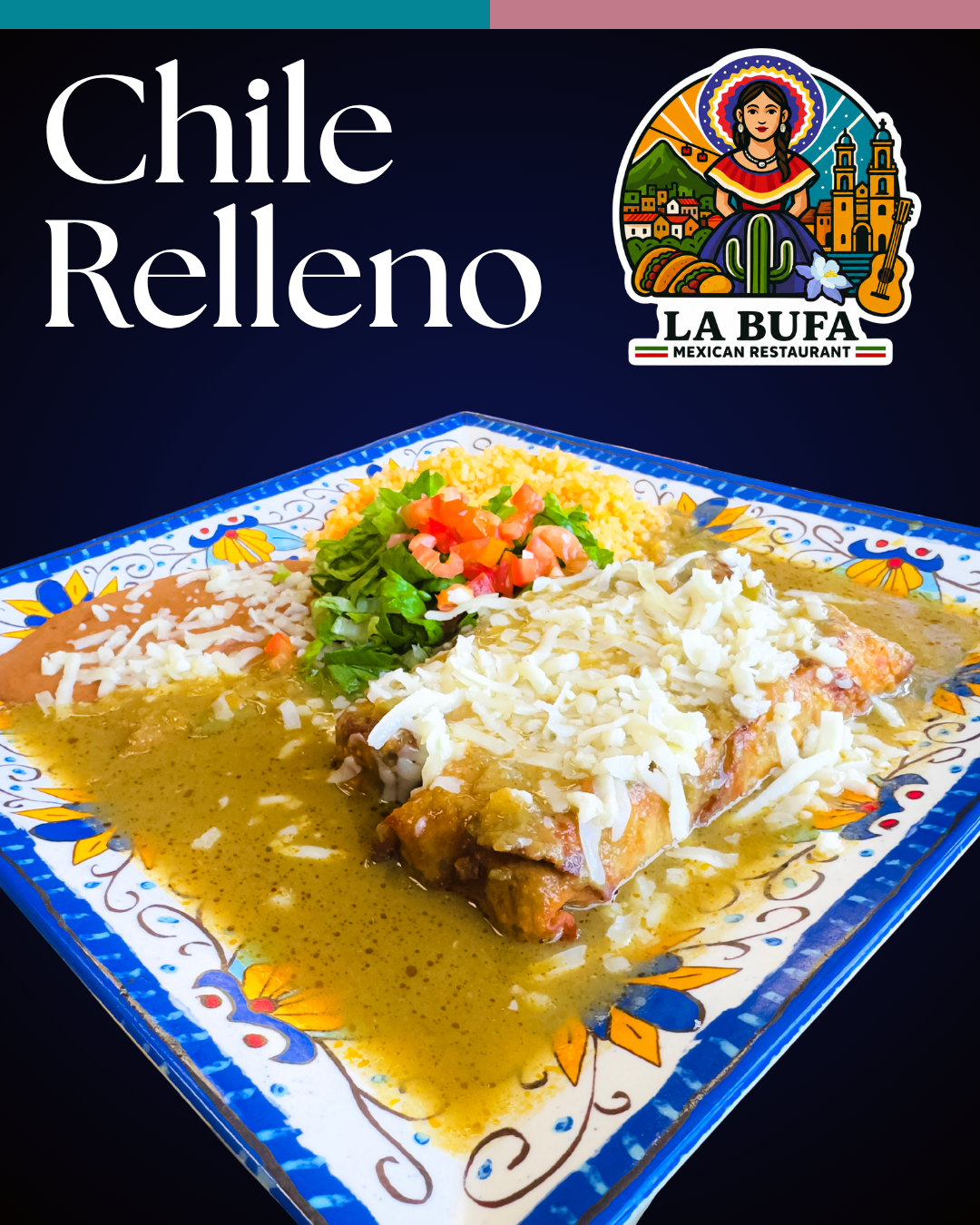
At La Bufa, we do the classic with a Tex-Mex twist — a poblano chile stuffed with Monterey Jack, dipped in egg batter, fried golden, and smothered in green chile sauce. We also do it egg roll style with Anaheim chile for a crispier twist on the original. Same soul, different crunch.
🌶 Fun fact: Did you know the jalapeño popper is technically a type of chile relleno? A stuffed chile, fried — same idea, just bite-sized.
Why It Still Matters
Food carries memory. When you eat a chile relleno, you’re eating something that has been passed down, argued over, adapted, and perfected for hundreds of years across two continents. That’s not nothing.
At La Bufa, we’re not trying to reinvent it. We’re just trying to do it right — the same way it’s been done by families who knew what they were doing long before any of us got here. Most importantly, doing it the way our grandma taught my mom. One thing we often overlook is that family recipes are how we connect not only to our roots but also to our ancestors we never got to meet or even know about. It’s our only connection to our indigenous roots, which are part of who we are today. Mexicans are a mix of many races and backgrounds that we often lose touch with, but food is a way to reconnect with them. Food is identity, and when we know who we are, we know what we are capable of, and we start living up to our full potential.
Come try it and taste the history yourself — and maybe even discover a little more of who you are and where your food comes from.
References & Further Reading
Want to dig deeper? Here are the sources we used for this post:
- A Little History of Chile Rellenos — Chevys Fresh Mex
- A Brief, Possibly True History of the Chile Relleno — The Bite NM
- Chiles Rellenos: A Family Tradition — Nibbles and Feasts
- Chiles Rellenos — Larousse Cocina (Diccionario Gastronómico Mexicano)
La Bufa Mexican Restaurant · 7124 Federal Blvd, Westminster, CO · @labufadenver